
From the Hudson's edge to 500 feet
Concrete Contractors in Troy, NY
Steps, walks, driveways and patios for a 19th-century city built on a riverbank and a steep hillside.
- Free estimate at your property, then a written price broken into line items
- Exterior mixes are air entrained and set on a compacted stone base, with joints laid out before the pour
- Curb, apron and public-sidewalk rules looked up for your street before anything is scheduled
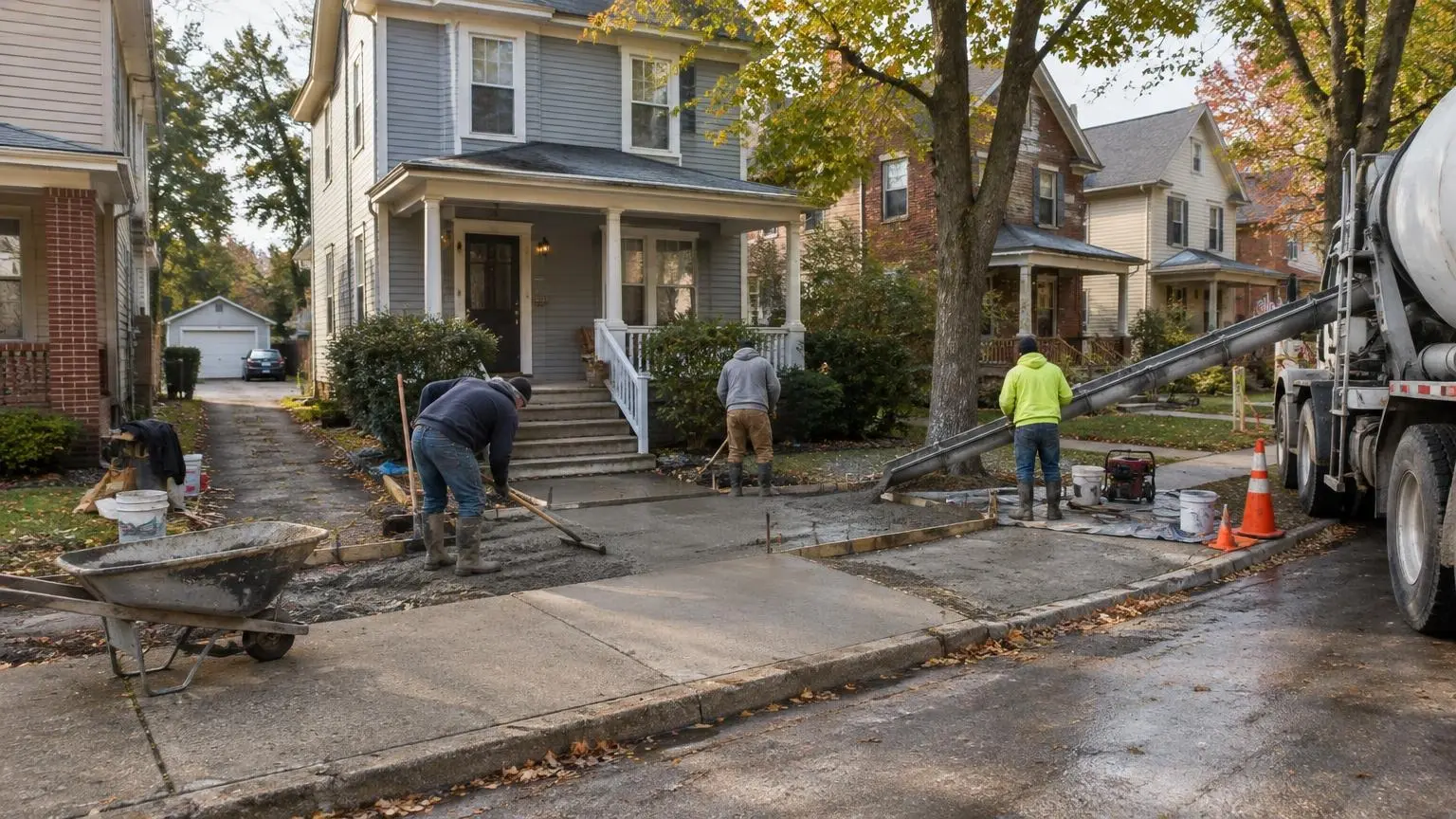
Concrete on a Hillside City
Troy is a hard city to pour concrete in, and that is exactly why homeowners look for concrete contractors who plan for slope. The western edge of the city is flat along the Hudson River, then the land rises sharply to the east, reaching about 500 feet at its highest point. Troy had 51,401 residents and 24,325 housing units in 2020, many of them on streets that tilt.
Steps, lots of steps
On a hillside, the front door is often well above or below the sidewalk. That means more risers, longer flights and landings, and more chances for something to go wrong. A good set of concrete steps in Troy needs:
- A footing below frost depth so the flight does not heave away from the house
- Even risers from top to bottom, including the first step off the sidewalk
- Landings where a flight is long enough to need a rest point
- A broom or textured finish for grip and a pitch that sheds water off each tread
We also plan for railings at the time of the pour, since anchors set into fresh concrete hold better than ones drilled later.
Driveways that climb
Where Troy homes have driveways at all, they often climb or drop steeply. On those we use a deeper broom texture, cut joints at closer spacing, and look at where runoff from uphill will cross the slab. A driveway that sheds water toward the garage needs a drain, not just a slope.
Where a yard drops away, a patio may need a raised edge or a thickened border so it does not undercut. Rather than pour a slab that floats over a slope on fill, we prefer to step the design: a lower patio, a short run of steps, then an upper landing near the door. Each level sits on a compacted base on firm ground, which holds up far better through a Troy winter than a single slab propped up on loose soil.
Old city, old foundations
Troy was chartered as a city in 1816, annexed Lansingburgh in 1900, and still has many examples of intact 19th-century architecture, especially in the Central Troy Historic District. The city has also nearly been destroyed by fire three times, including the Great Troy Fire of 1862. Homes that old often have stone or brick foundations that do not like water against them. When we replace a walk or a patio next to one, we slope the new concrete away firmly and leave an isolation joint at the wall.
Creeks and neighborhoods
The Poesten Kill and the Wynants Kill are Troy's two largest creeks, and Downtown and South Troy sit on the land between them along the Hudson. Lansingburgh, often called North Troy, is a former village with its own older housing. Properties near creeks or on the low riverside flats may deal with wet ground, while hillside properties deal with runoff from above. Either way, drainage drives the design.
Public walks on steep blocks
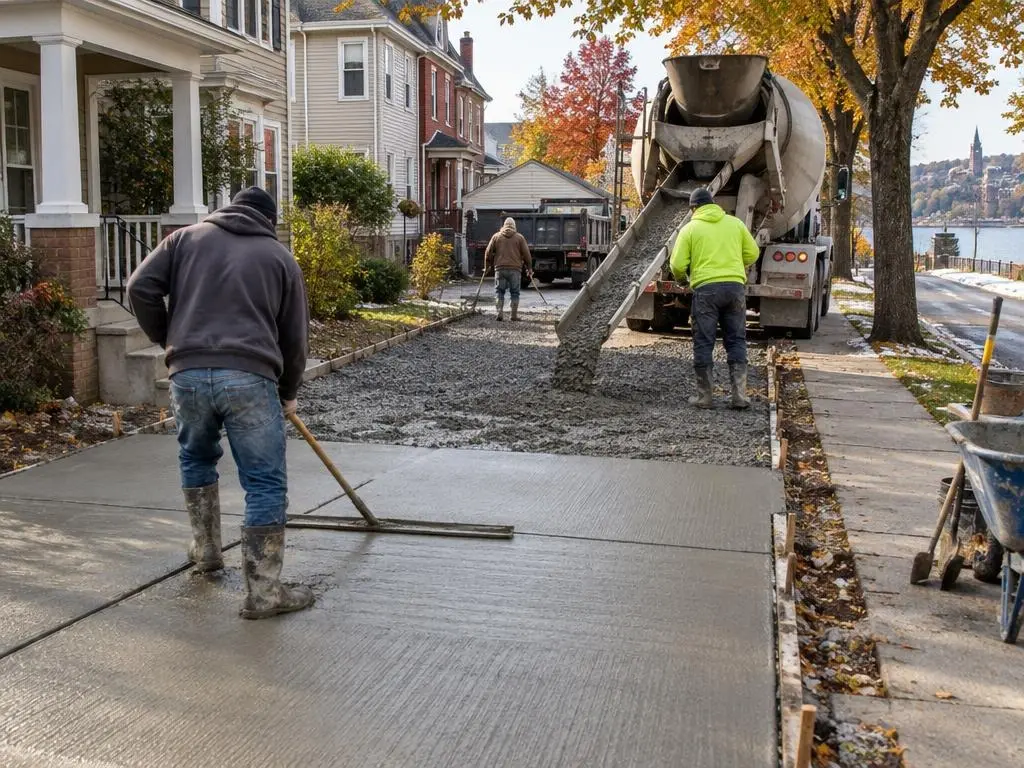
On Troy's hillside streets, the public sidewalk often climbs with the grade, and the walk up to the house may meet it at an awkward angle. Replacing those sections means matching the slope of the walk on either side, keeping joints square to the direction of travel, and giving the surface enough texture to stay usable in ice. Before any work on the public sidewalk or in a historic district, we check with the City of Troy on what it requires.
Troy Ground Conditions
- Steep terrain. The western edge is flat along the Hudson River, then rises sharply to the east, with a high point of about 500 feet.
- Housing. The 2020 census counted 51,401 residents and 24,325 housing units, many in 19th-century neighborhoods.
- City history. Troy was chartered as a city in 1816 and annexed Lansingburgh in 1900; the Great Troy Fire of 1862 led to major rebuilding.
- Two creeks. The Poesten Kill and Wynants Kill are the largest creeks, with Downtown and South Troy on the land between them.
Troy Questions
Our front steps in Troy have pulled away from the house. Why?
Usually the footing was too shallow, so frost lifted the steps or the soil beneath settled. A rebuild with a proper footing below frost depth solves it.
Can you pour a driveway on a steep Troy lot?
Yes. We use a deep broom finish for traction, closer joint spacing and drainage planned for runoff coming from uphill.
Can railing posts be set in new concrete steps?
Yes, and that is the ideal moment to do it. We set sleeves or anchors during the pour so the railing is solid from day one.
Free Estimates in Troy, NY
Free estimates for steps, walks and driveways across Troy.
Concrete Contractors Near Troy
- Concrete Contractors in Schenectady, NY
- Concrete Contractors in Niskayuna, NY
- Concrete Contractors in Rotterdam, NY
- Concrete Contractors in Glenville, NY
- Concrete Contractors in Scotia, NY
- Concrete Contractors in Clifton Park, NY
- Concrete Contractors in Colonie, NY
- Concrete Contractors in Latham, NY
- Concrete Contractors in Loudonville, NY
- Concrete Contractors in Albany, NY
- Concrete Contractors in Cohoes, NY
- Concrete Contractors in Watervliet, NY
- Concrete Contractors in Guilderland, NY
- Concrete Contractors in Bethlehem, NY
- Concrete Contractors in Halfmoon, NY
- Concrete Contractors in Ballston, NY
- Concrete Contractors in Ballston Spa, NY
- Concrete Contractors in Malta, NY
- Concrete Contractors in Saratoga Springs, NY
- Concrete Contractors in Waterford, NY
- Concrete Contractors in Amsterdam, NY
- Concrete Contractors in Duanesburg, NY